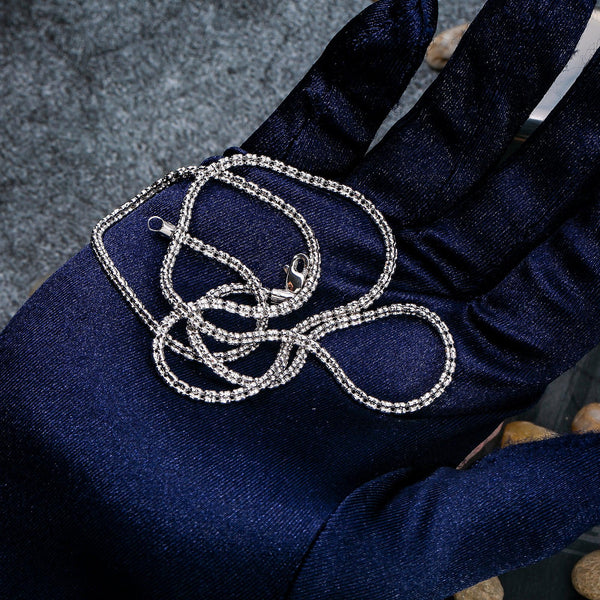
In the high-stakes world of luxury jewelry, few pieces command as much immediate attention as a fully flooded chain. Often referred to as a masterpiece of “ice,” these pieces represent the pinnacle of a jeweler’s technical ability and a collector’s personal success. While the term was once reserved for the red carpets of the music industry, it has evolved into a sophisticated staple for any high-end wardrobe. To the uninitiated, it might just look like a lot of sparkle, but to the seasoned connoisseur, an iced-out piece is a complex landscape of light, geometry, and precision setting. It is the ultimate crossover between a heavy gold investment and a high-gemology exhibition, designed for those who don’t just want to walk into a room, but want to own the atmosphere of it.
The Architectural Foundation of a Flooded Link
Before a single diamond is ever placed, the foundation of the chain must be flawlessly constructed. A nice chain is fundamentally different from a plain gold link because it must be engineered to hold weight without sagging or kinking. A master jeweler starts with a solid gold base, usually 14k or 18k, ensuring the walls of each link are thick enough to support the drilling of hundreds of tiny holes. If the gold is too thin, the structure becomes brittle. This is why a premium iced piece often feels significantly heavier than it looks. The links are hand-filed and polished to create a perfectly flat surface, providing a pristine canvas for the stones. Without this rigorous structural preparation, even the best diamonds in the world would look disorganized and dim.
The Art of the Pavé and Honeycomb Setting
The “ice” effect is achieved through a meticulous process called pavé setting, where small diamonds are set so closely together that the metal underneath virtually disappears. In the most elite workshops, we use a honeycomb pattern. This technique involves staggering the stones like the cells of a beehive to eliminate any “dead spots” of visible gold. When you look at a high-quality chain, you shouldn’t see rows of metal; you should see a continuous, shimmering ribbon of fire. Achieving this level of density requires a steady hand and a microscopic eye. Each stone is held in place by tiny beads of gold, hand-raised by the setter. If these beads are too large, they overshadow the diamonds; if they are too small, you’ll be hunting for lost stones on the dance floor. It is a delicate balance of physics and aesthetics.
Diamond Quality and the Fire vs. Brilliance Debate
When buying a statement chain, the clarity and color of the stones are non-negotiable. Many entry-level pieces use “frozen” or cloudy diamonds that lack life, but a true luxury chain utilizes VS or VVS clarity stones. Why does this matter? Because in a piece with hundreds of stones, any “inclusion” or dark spot acts like a thumbprint on a mirror. You want diamonds that offer both brilliance, which is the white light reflection, and fire, which is the rainbow-colored flashes. High-color grades (D through F) ensure that the stones look icy white rather than a murky yellow. When these stones are cut with perfect proportions, they catch light from every angle, creating that signature “blinding” effect that defines the modern luxury trend.
The Hidden Complexity of Movement and Fluidity
A common pitfall in the design of iced-out jewelry is stiffness. When you add stones and prongs to a metal link, you risk locking the joints. A chain that sits like a rigid hula hoop around your neck is a sign of poor craftsmanship. A masterfully crafted piece must maintain the fluidity of liquid. Each link should rotate freely, allowing the chain to drape naturally over the collarbone and move with the wearer’s body. This fluidity is essential because as the chain moves, the diamonds are constantly introduced to new light sources, creating a dynamic, shimmering effect. Achieving this “silk-like” movement while the chain is encrusted with hard gemstones is one of the most difficult feats in the jewelry world, and it is exactly what separates a mass-produced item from a bespoke masterpiece.
Longevity and the Importance of the Finish
The final stage of creating a world-class chain is the finishing and the clasp. For a piece this substantial, a standard clasp is simply not enough. We look for a custom-integrated box lock that is also iced-out to match the rest of the chain. This ensures the visual flow is never interrupted, even at the back of the neck. Furthermore, the “under-gallery” of the chain, the part that touches your skin, should be smooth and often features intricate laser-cut patterns. This not only adds a hidden layer of luxury but also allows for easier cleaning. Over time, skin oils and dust can dull the underside of the diamonds. A well-designed gallery allows light to pass through and makes it possible to maintain that “day one” sparkle for decades to come.
Choosing Your Signature Statement Piece
Investing in an iced-out chain is a declaration of your personal style and a commitment to quality that transcends seasonal trends. It is a piece that combines the raw, masculine energy of heavy gold with the refined elegance of high-grade diamonds. When you choose a chain that prioritizes structural integrity, stone density, and fluid movement, you aren’t just buying jewelry; you are acquiring a wearable asset that will retain its luster and prestige for a lifetime. Whether you prefer the classic look of white gold or the bold warmth of yellow gold, the key is to look for the details that only a master jeweler can provide. Your jewelry should be as bold and multifaceted as the life you lead.