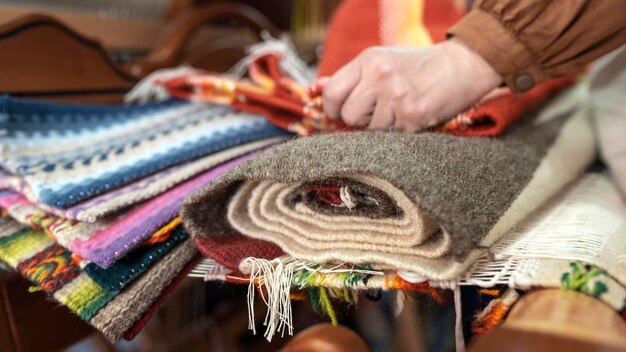
Looking to give an authentic look to your living room with a handmade rug? Then you are at the right place. In this guide, we will walk you through a complete guide to choosing a quality handmade rug for your home.
No matter how beautiful a machine-manufactured rug is, you cannot deny the appeal of a handmade rug. Especially in India, handmade rugs carry a legacy of craftsmanship. Each piece of handmade rug is an art that carries centuries of history, culture, and craftsmanship of the country.
The same is applicable for rugs made outside of India. For example, if you choose to purchase a Moroccan Berber rug, you carry home the century-old culture of Amazigh tribes from the Atlas Mountains of Morocco.
But how do you know that you are taking home a handmade rug? Scroll down to the next section, so you don’t have to ask yourself this question in the shop.
What is a Handmade Rug?
A handmade rug is also known as a hand-knotted and hand-woven rug, because the skilled artisans carefully craft the rug knot by knot. These rugs are made from durable threads of wool, cotton, and silk. The knots are carefully tied into the foundation of the rug to create a dense, durable, and long-lasting weaving pattern.
It might come as a surprise to you, but yes, these rugs are not manufactured in factories, but artisans invest weeks, or even months and years to craft a beautiful woven rug. Knowledge that has been passed down to generations goes into crafting these rugs.
When you go to a retail outlet of a rug manufacturer in India, look for a section of unique handmade rugs; it will be worth the investment.
How to identify if a Rug is Handmade: A Quick Guide
Suppose you have found the ‘Handmade-Rug’ corner in the retail showroom, now how do you know if these are truly handmade rugs? Take a look at the following tips:
Inspect the Back of the Rug
The back of handmade rugs can tell you a lot about them: the weaving technique, material, knot density, pile heights, and more. You will also see a series of individual knots that are tied at the foundation of the rugs. The more knots mean a denser and higher-quality rug.
Visible Design on Both Sides
If it is a handmade rug, you will see visible designs on both sides. It is a sign of true craftsmanship and skill, where the craftsman takes time to reflect the rug design on both sides by carefully weaving it. On the other hand, designs on the machine-made rugs may not be visible on both sides due to cost reduction and increasing production efficiency.
Look at the edges
You can clearly differentiate between a handmade natural rug in India from a machine-made rug by looking at the edges. Handmade rugs have hand-bound edges using yarn or fabric. On the other hand, a machine-made rug will have machine-sewn edges.
Rug Texture and Quality
High-quality rug materials like wool, silk, and cotton are used in the manufacturing of handmade rugs. When you touch these rugs, you can instantly feel the soft and luxurious texture of the carpets. Check if the rug feels too synthetic, then it might be a sign of hand-tied rugs.
Imperfections Equal Authenticity
As handmade rugs are made by individual artisans, design and finishing uniformity cannot be maintained throughout the process. An individual knot might look different from the other, or the floral design may not be the same throughout the rug. Check for these signs to be sure of its authenticity.
Look for natural rugs in India that guarantee the authenticity of hand-knitted or hand-woven rugs and give your home a unique touch.
How to Maintain Handmade Rugs?
Caring for the handmade rug depends on the rug material and the interval of care: weekly, monthly, and yearly.
Weekly Care
Take a low-suction vacuum for a wool or silk rug and gently vacuum in the pile direction. Do not use beater bars; they may damage the threads of the rugs. Shake it gently to keep the rug fibres lively.
Monthly Care
Start by rotating the rug to expose the other side of it to the spotlight. Or, you can flip it, if it is a flatweave rug. But before that, take it outside and shake it like you mean it.
If it has a musty scent or smells like your pet, sprinkle baking soda over it, leave for 30 minutes, and use a vacuum cleaner to remove it.
Yearly Care
If you have not cleaned the rug for a year or two, send it to a professional rug cleaner. Also, consider a little reweaving of the handmade rug or use a dye to make it look sharp and lively. A yearly restoration of the rug will help increase its longevity.
Conclusion
Identifying handmade rugs requires an expert eye and experience to feel the texture and quality of the material. Differentiating an authentic handmade rug from a machine-made one will help improve your room environment.
Buy a Handmade Rug, Enhance Your Home Environment
Look for reliable natural rugs in India that guarantee the authenticity of handmade rugs and give your living room a new look.