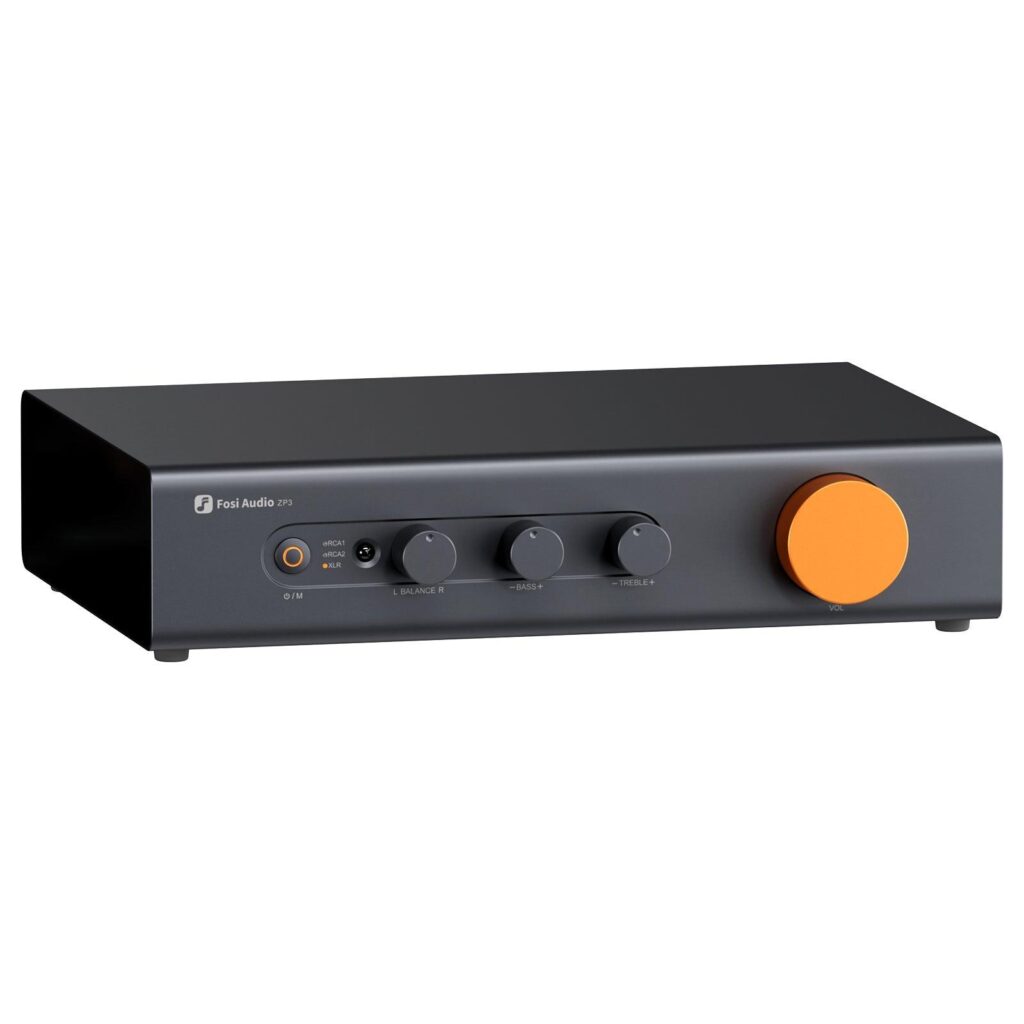
If your receiver or amplifier already has a phono input, the obvious question is why anyone would buy a separate box to do the same job. It is a fair question, and the honest answer is: sometimes you should not. But sometimes the difference is real, and knowing which situation you are in saves both money and disappointment.
The comparison is worth making carefully, because the two options are not just “cheap versus expensive” versions of the same thing. A dedicated phono preamplifiers and a built-in phono input live in different electrical environments, are designed to different priorities, and fail in different ways. Here is how to judge them on their merits.
What a Built-In Phono Input Really Is
A built-in phono input is a small circuit added to a much larger product. It shares a power supply with the amplifier, sits on a crowded circuit board next to digital processing and radio tuners, and was designed to a cost target within a product whose main job is something else. None of that makes it bad — many are perfectly competent — but it does mean the phono circuit was never the star of the show.
That shared environment is the key weakness. It is the main reason phono preamplifiers exist as a separate product category. Noise from the amplifier power supply, interference from nearby digital circuits, and cost-driven component choices all show up in the most sensitive signal in the system. A built-in input can sound perfectly fine, especially in a quiet room at moderate volume, but it is working with one hand tied behind its back.
Where a Dedicated Stage Wins
Separate phono preamplifiers have one job and a power supply of their own. Its circuit board is laid out for a tiny, delicate signal rather than squeezed around other functions. The practical results are usually lower noise, more accurate equalization, and better overload handling on loud passages — the things that make records sound clean rather than merely audible.
Dedicated phono preamplifiers also tend to offer proper gain and loading options for different cartridges. A built-in input is almost always fixed at standard moving-magnet settings. If you ever move to a low-output moving-coil cartridge, or a cartridge with unusual loading needs, the built-in input simply cannot follow you, while a decent dedicated stage often can.
- Lower noise floor: its own power supply, no digital neighbors.
- Better equalization accuracy: designed for one job only.
- Flexibility: gain and loading options for more cartridges.
When the Built-In Input Is Genuinely Enough
Let us be honest about the other side. If you listen casually, at modest volume, with a standard moving-magnet cartridge, and your built-in input is quiet between tracks, separate phono preamplifiers may buy you very little you can actually hear. The law of diminishing returns arrives early in this hobby, and plenty of listeners would do better spending the same money on records.
The built-in input is also the right answer when simplicity matters: one box, one remote, no extra cables, no extra shelf space. A system you enjoy using beats a theoretically better one that annoys you. If your current setup already makes you happy, the burden of proof is on the upgrade, not on you.
How to Compare Them Fairly
If you do want to test the difference, do it properly. Borrow or buy dedicated phono preamplifiers from somewhere with a return policy, connect it to a line input on the same receiver, and level-match the volume carefully — even a small volume difference will make the louder option sound “better” regardless of quality. Listen to records you know well, and pay attention to the quiet parts: the silence between tracks, the decay of a piano note, the space around a voice.
Give it a few days. First impressions favor the new and the louder; real differences show up over repeated listening, when you notice you are hearing details you had stopped noticing, or that listening fatigue has quietly gone down. One more comparison tip: use the same record, played twice, once through each option, rather than two different records. Pressing differences between records are larger than most phono stage differences, and comparing different pressings tells you about the pressing, not the electronics. Keep everything else identical — same volume, same speakers, same seat — and the comparison stays honest. If after a week you cannot honestly tell, return it and enjoy the money you saved. That is a successful test, not a failed one.
A dedicated phono stage is not a magic upgrade, and a built-in input is not a disgrace. They are two reasonable answers to the same problem, separated by noise, flexibility, and cost. Compare them in your room, with your records, at matched volume — and let your ears, not the internet, make the call.