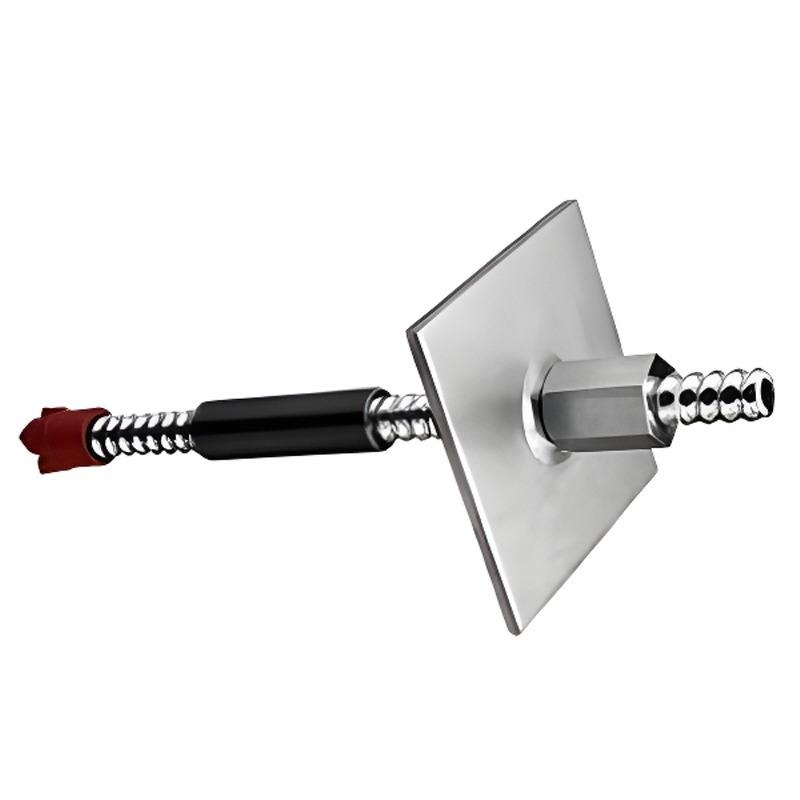
Some ground does not cooperate. Loose soil, fractured rock, and collapsing boreholes defeat conventional anchors before they even get started, because the hole falls in before the bar goes in. That is the problem an IBO hollow bar was designed to solve.
Instead of drilling a hole first and then inserting a bar, this system drills and anchors in a single pass. The result is a reliable anchor in ground where traditional methods fail, installed faster and with less equipment on site.
How the system works
The core of the system is a hollow steel bar with a continuous thread along its length. A sacrificial drill bit is fitted to the leading end, and the bar itself becomes the drill string: rotation and flushing fluid are applied through the hollow centre, carrying cuttings out as the bar advances.
Because the bar stays in the hole as drilling proceeds, the borehole cannot collapse around it. In loose or broken ground, this is the decisive advantage — the hole is cased by the very element that will become the anchor. Once the bar reaches its design depth, grout is pumped through the hollow centre, filling the annulus and bonding the bar to the surrounding ground.
The external thread serves a second purpose after installation. It lets couplers join bars for greater depths, and it lets nuts and plates be attached at the surface to transfer load into the structure. The whole assembly — bar, grout, and plate — works as one anchored system.
Where it gets used
Tunnelling is the classic application. An IBO hollow bar provides face support, canopy tubes, and radial bolting in ground that would otherwise need slow, expensive pre-support. Slope stabilisation is another: bars installed through unstable soil into firm strata hold back embankments and cuttings, often with shotcrete facing.
Foundations and underpinning benefit too. Micropiles formed with hollow bars can be installed in restricted spaces with compact rigs, making them practical for underpinning existing buildings and for sites where access is tight. Retaining walls, dam works, and landslide repair all use the same principle: drill through the bad ground, anchor in the good.
Why engineers choose it
Speed is the first reason. Combining drilling and installation into one operation cuts out the separate casing and insertion steps that slow conventional anchors, and fewer steps mean fewer chances for a hole to fail mid-installation. On a tunnelling face or a busy slope, that time saving is real money.
Versatility is the second. The same system adapts to soil, weathered rock, and fractured rock simply by changing the drill bit and grout mix. Bar diameters and steel grades cover a wide range of loads, and bars can be coupled to reach depths that a single length cannot.
The third reason is reliability of the grout bond. Because grout is injected through the bar itself under pressure, it fills voids around the bar more completely than gravity grouting from the surface. A well-grouted anchor performs predictably — and predictability is what engineers are paying for.
Choosing and specifying
Specification starts with ground conditions and load requirements. A geotechnical investigation tells you what the bar must drill through and what it must anchor into; the bar diameter, steel grade, and grout strength follow from that. Corrosion protection matters for permanent works — galvanising, epoxy coating, or double corrosion protection for aggressive ground or long design lives.
Installation quality deserves as much attention as the product. Drill flush pressures, grout volumes, and installation records should be checked against the design, and proof testing a sample of anchors confirms the system performs as intended. A good installer with the right rig matters as much as the bar itself.
If you are comparing systems for a project, reviewing a dedicated IBO hollow bar product range helps clarify the options: bar sizes, drill bit types, and accessories for the ground conditions you are actually facing.
Safety and quality checks
Site safety starts with the rig: stable footing, guarded moving parts, and an exclusion zone around the drilling operation. Grout under pressure deserves respect — check hoses and couplings before each shift, and never stand in line with a pressurised connection.
Quality checks run alongside: record drilling parameters, grout volumes, and bar depths for every installation, and proof-test a sample of anchors to confirm they meet design loads. An IBO hollow bar installation is only as good as its records — good paperwork turns a good installation into a verifiable one.
Finally, protect the finished work. Cap exposed bar ends, guard against mechanical damage during follow-on trades, and keep corrosion protection intact where specified. Anchors are easy to damage after installation and expensive to replace.
Self-drilling hollow bar anchors exist for the ground that refuses to cooperate. By drilling and anchoring in one pass, they turn collapsing, fractured, or loose ground from a show-stopper into a routine installation — faster, more reliable, and often cheaper than the alternatives.